Library and Information Sciences

Library and Information Sciences

No. of Volumes

28

No. of Issues

108

No. of Articles

1,010

No. of Contributors

1,249

Article View

1,555,580

PDF Download

665,284

View Per Article

1540.18

PDF Download Per Article

658.7


No. of Submissions

1,361

Rejected Submissions

912

Reject Rate

67

Accepted Submissions

306

Acceptance Rate

22

Time to Accept (Days)

80

No. of Indexing Databases

36

No. of Reviewers


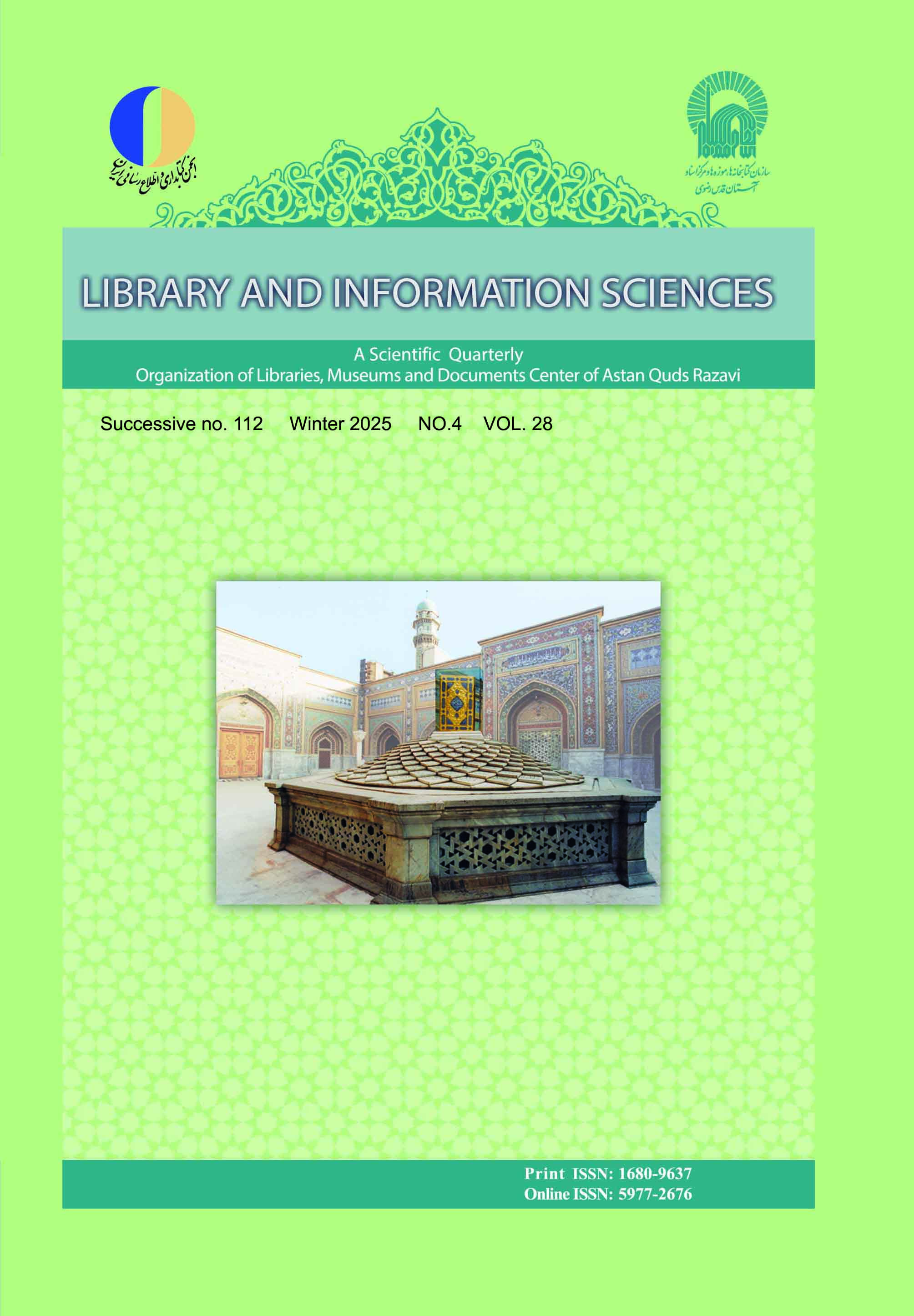
Library and Information Sciences (also known as Iranian Journal of Library and Information Science) is a peer-reviewed international journal published by the Central Library of Astan Quds Razavi. Library and Information Sciences, a cross-disciplinary and refereed journal, focuses on the research process in library and information science as well as research findings and, where applicable, their practical applications and significance. The target audience of the journal includes librarians, information scientists, specialists, managers, and educators. The journal aims at publishing the research papers with the most recent issues and developments in the field. All papers are subject to a double-blind reviewing process. This journal is known as "Kitābdārī va iṭṭilāʻrasānī" in persian language. 

Rank: Scientific
Publication Date: Quarterly
Journal Language: Bilingual; Persian (Abstract in English)

   Access: Open access

Conflict of Intrest form


Current Issue: Volume 28, Issue 3 - Serial Number 111, Winter 2026 

Publication Information

Publisher

Director-in-Charge
Editor-in-Chief
Executive Manager
Editor

Frequency
Quarterly
Print ISSN
Online ISSN

Keywords Cloud

  • Public libraries
  • Librarians
  • Knowledge Management
  • Information Retrieval
  • knowledge sharing
  • Libraries
  • Academic Libraries
  • Iran
  • Faculty Members
  • Knowledge and Information Science
  • Systematic review
  • Digital Libraries
  • Social Networks
  • Grounded theory
  • Voluntary Activities
  • Public Library
  • Trust
  • Education
  • Astan Quds Razavi
  • Information organization
  • Publishers
  • content analysis
  • library
  • Ferdowsi university of Mashhad
  • Information technology
  • Artificial intelligence
  • Scientometrics
  • copyright
  • Meta-Synthesis
  • Timurid era
  • Knowledge organization
  • Scientometric
  • Knowledge
  • Researchers
  • Manuscript
  • Information needs
  • Museum
  • Folksonomy
  • Central Library of Astan Quds Razavi
  • semantic technology
  • Organizational Justice
  • Iranian Libraries
  • Social Media
  • Marketing
  • usability
  • Altmetrics
  • National library and Archives of Iran
  • Information Literacy
  • Razi University
  • Co-word Analysis
  • Research
  • Information Management
  • manuscripts
  • children
  • ontology
  • Cataloging
  • creativity
  • Ministry of Science
  • Students
  • future
  • Instagram
  • Scopus
  • Waqf
  • knowledge management implementation
  • storytelling
  • Digital archives
  • model
  • Islamic countries
  • online scientific social network
  • Websites
  • Digital literacy
  • Information technologies
  • Social Capital
  • E-reader Applications
  • Co-authorship
  • Conceptual Models
  • National library of Iran
  • Anxiety
  • semantic tools
  • Knowledge management model
  • Persian Gulf University
  • Delphi study
  • Volunteer Forces
  • Social tagging
  • user loyalty
  • Research Data
  • Mashhad
  • jurisprudential manuscripts
  • Safavid period
  • correction
  • Interdisciplinarity
  • Central Library of Tabriz
  • SID
  • Librarian
  • scientific virtual communities
  • Library Software
  • Scientific productions
  • experience
  • Personal information management
  • Information services
  • library services
  • Persian scientific databases
  • University Libraries
  • Higher education
  • publishing
  • Persian script
  • Writing words continuously
  • Reading
  • Gamification
  • Structural Equations
  • Knowledge sharing behavior
  • Health literacy
  • Bibliometrics
  • Documentation
  • Entrepreneurship
  • digital library
  • Shiraz University
  • research performance
  • organizational trust
  • Thematic Analysis
  • Theory of Planned Behavior
  • Magiran
  • structural equation modeling
  • Organizational health
  • Hospital
  • cooperation
  • E-learning
  • Holy Quran
  • translation
  • Future Studies
  • Review and Critique
  • Proverb
  • Network Society
  • Value
  • Public Participation
  • Attitude
  • Color
  • Critical Correction
  • Aerospace engineering
  • Yoga
  • School
  • Virtual Space
  • Teachers
  • services
  • Tehran City
  • evaluation
  • culture
  • depression
  • Islam
  • Iranian Law
  • social semiotics
  • research productivity
  • Dust
  • social network
  • Quran
  • Islamic Azad University
  • Evaluation indicators
  • Phenomenology
  • Civilization
  • Historiography
  • دانشگاه
  • Inhibiting factors
  • Quality Function Deployment
  • organizational learning
  • Timurid period
  • Work
  • Growth Factors
  • Representation
  • communication
  • myth
  • organization
  • Women
  • shyness
  • Conservation
  • Scientific collaboration
  • psychology
  • Validation
  • Iraq
  • University of Tehran
  • science policy
  • Media Literacy
  • organizational silence
  • Challenges
  • Nomads
  • Jami
  • religious values
  • Quality
  • Space
  • Tehran University
  • recall
  • Khorasan Razavi
  • Image Retrieval
  • reaction
  • Visibility
  • Organizational Intelligence
  • Knowledge-based companies
  • behavioral factors
  • hebr
  • Shannon Entropy
  • Architecture